MATERIALS SCIENCE. PRODUCT PROGRESS.
Understand your material.
Advance your product.
Expert analytical testing that connects material properties to real product performance.
Focused, non-GLP studies for R&D, preclinical development, and exploratory work. The right measurements for your next decision.
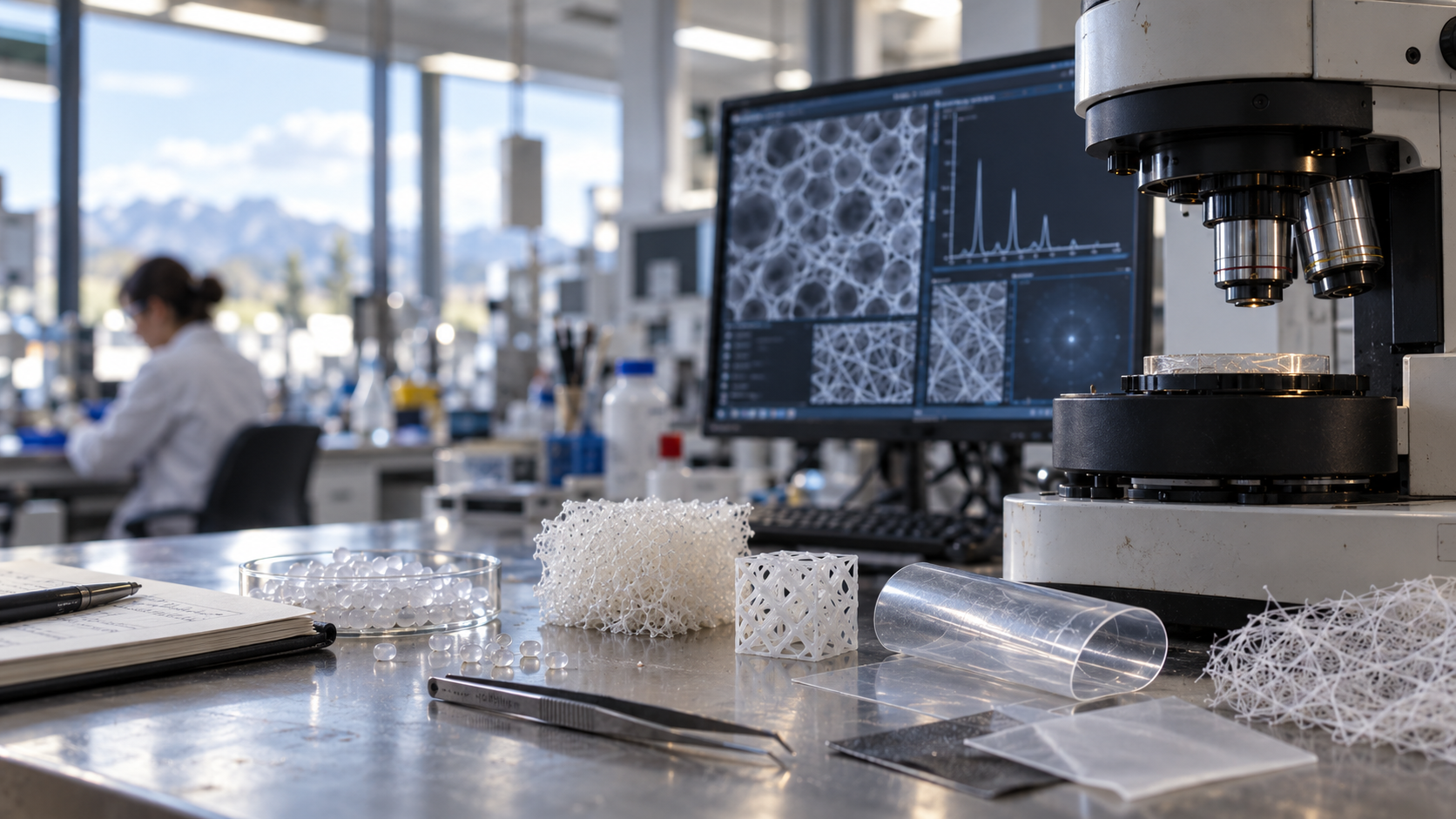
THE RIGHT TOOL FOR THE QUESTION
A broad view of
your material.
Determine how processing changes material structure, and how that structure governs function. We combine complementary measurements with degradation studies, drug-release kinetics, and tailored experiments to guide precise adjustments and predict performance within the conditions studied.
01
Spectroscopy
Composition & molecular structure
+

Cropped from Spectre.svg by Tatoute and Phrood~commonswiki · CC BY-SA 3.0
Composition & molecular structure
FTIR spectroscopy
Identify polymer chemistry and compare material fingerprints to investigate formulation changes, contamination, or degradation.
Composition & molecular structure
Raman spectroscopy & microscopy
Probe molecular structure and map chemical differences across a sample to investigate crystallinity, phase distribution, and local defects.
Composition & molecular structure
Nuclear magnetic resonance (NMR)
Investigate molecular structure and composition to support material identification, formulation assessment, and reaction development.
Composition & molecular structure
UV–visible spectroscopy
Measure optical absorption to compare concentrations, optical properties, and changes during stability or release experiments.
Composition & molecular structure
Fluorescence spectroscopy
Detect fluorescent species and changes in their environment to support sensitive formulation comparisons and exploratory release studies.
Composition & molecular structure
FTIR microscopy
Combine spatial imaging with chemical fingerprints to examine small particles, localized residues, or heterogeneous regions.
Composition & molecular structure
Circular dichroism & spectropolarimetry
Investigate optically active molecules and changes in molecular conformation to compare solution conditions and formulation behavior.
Composition & molecular structure
Stopped-flow kinetics
Follow rapid spectroscopic changes after mixing to investigate reaction rates and formulation-dependent interactions.
02
Microscopy
Morphology, surfaces & defects
+

Image: NU iGEM · CC BY 4.0
Morphology, surfaces & defects
Scanning electron microscopy (SEM)
Examine fine surface morphology, fibers, particles, and fracture features to connect microstructure with performance or failure.
Morphology, surfaces & defects
Digital & optical microscopy
Document surface defects, sample dimensions, and visible features to compare prototypes and investigate manufacturing variability.
Morphology, surfaces & defects
Inverted & fluorescence microscopy
Examine suitable transparent or fluorescent specimens to assess morphology, distribution, and changes across experimental conditions.
03
Mechanical analysis
Strength, deformation & durability
+
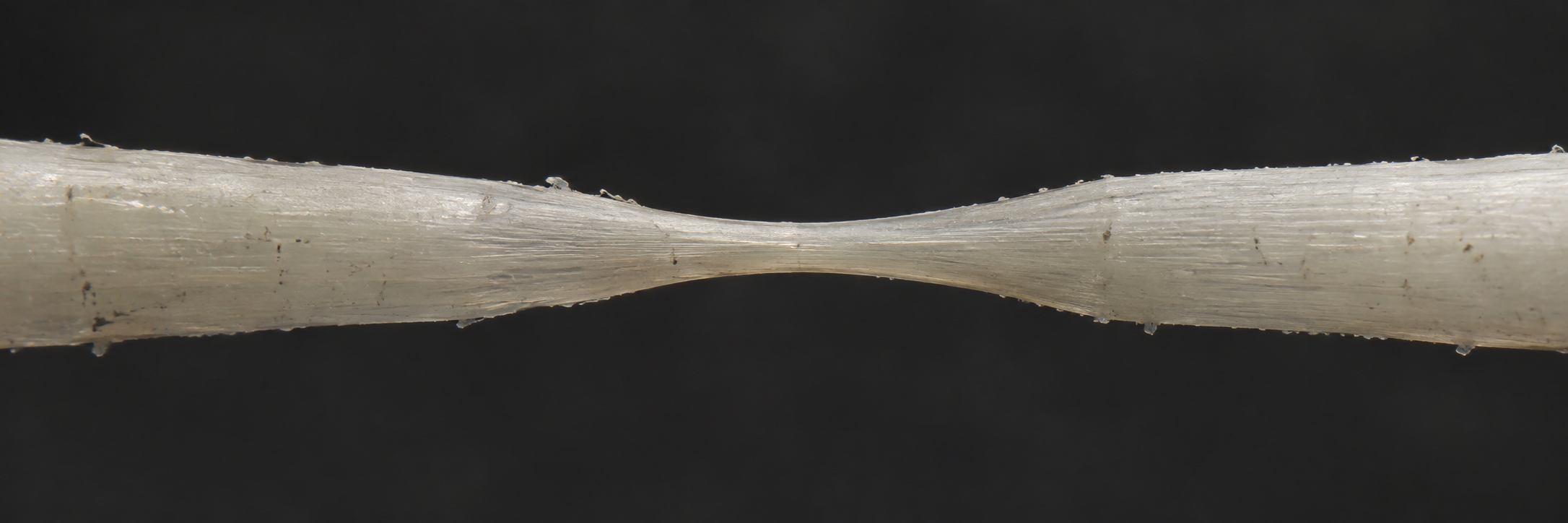
Strength, deformation & durability
Tensile, compression & flexural testing
Measure material response under load to compare strength, stiffness, and deformation. Fixtures and specimen geometry are selected for the study.
Strength, deformation & durability
Impact testing
Compare response to sudden loading to investigate brittle failure and screen materials or coatings for handling-related damage.
Strength, deformation & durability
Coating hardness
Use pencil or pendulum hardness measurements to compare coating cure and resistance to surface deformation.
04Rheology & viscoelasticity
Flow, handling & time-dependent response+

Image: Olli Niemitalo · CC0
Flow, handling & time-dependent response
Rotational rheometry
Measure viscosity across relevant shear conditions to compare gels, liquids, and polymer formulations for mixing, coating, or dispensing.
Flow, handling & time-dependent response
Oscillatory rheology
Compare elastic and viscous response to investigate gel structure, formulation consistency, and changes with temperature or time.
Flow, handling & time-dependent response
Dynamic mechanical analysis (DMA)
Measure stiffness and damping as conditions change to understand viscoelastic behavior and guide polymer selection.
05Thermal analysis
Transitions, stability & processing windows+

Image: Giovanna Canu & Eva Santini · CC BY 4.0
Transitions, stability & processing windows
Differential scanning calorimetry (DSC)
Measure melting, crystallization, and glass transitions to compare thermal history, crystallinity, and processing conditions.
Transitions, stability & processing windows
Thermogravimetric analysis (TGA)
Track mass changes with temperature to investigate thermal stability, volatile content, and remaining inorganic residue.
Transitions, stability & processing windows
Thermomechanical analysis (TMA)
Measure dimensional change with temperature to assess expansion, softening, and compatibility between product components.
Transitions, stability & processing windows
Modulated & photo-DSC
Resolve overlapping thermal behavior or examine light-driven cure to support polymer formulation and process development.
Transitions, stability & processing windows
Bomb & solution calorimetry
Measure heat associated with combustion or solution processes to investigate energy content and relevant thermal interactions.
06Chromatography & mass spectrometry
Separation, composition & molecular weight+

Image: Tom Hall · CC BY 4.0
Separation, composition & molecular weight
High-performance liquid chromatography (HPLC)
Separate and measure suitable solution components to compare formulations, monitor stability, or quantify release in exploratory studies.
Separation, composition & molecular weight
Gas chromatography (GC)
Separate volatile compounds to investigate residual solvents, formulation differences, and process-related changes.
Separation, composition & molecular weight
Liquid chromatography–mass spectrometry (LC–MS)
Combine separation and mass information to investigate suitable nonvolatile components, degradation products, or unknown sample differences.
Separation, composition & molecular weight
Gas chromatography–mass spectrometry (GC–MS)
Investigate volatile and semivolatile compounds to support contamination troubleshooting and exploratory residual analysis.
Separation, composition & molecular weight
Polymer chromatography (GPC / APC)
Compare molecular-weight distributions to investigate polymer consistency, chain degradation, and processing effects.
Separation, composition & molecular weight
Flash chromatography
Separate and enrich components for downstream characterization or exploratory formulation and synthesis work.
07Surface, particle & chemical properties
Interfaces, composition & dispersion+

Image: Rohini · CC BY-SA 3.0
Interfaces, composition & dispersion
Particle size analysis
Compare particle-size distributions to investigate dispersion consistency, agglomeration, and formulation behavior.
Interfaces, composition & dispersion
BET surface area & gas sorption
Characterize accessible surface area and adsorption behavior to compare powders or porous materials and investigate processing effects.
Interfaces, composition & dispersion
Contact angle & surface wetting
Compare liquid wetting on surfaces to guide coating choices, surface treatment, and adhesive or interfacial performance.
Interfaces, composition & dispersion
Tensiometry
Investigate surface or interfacial tension in suitable systems to understand wetting, coating, and formulation interactions.
Interfaces, composition & dispersion
Refractometry
Measure refractive index to compare optical properties and assess consistency in suitable liquid formulations.
Interfaces, composition & dispersion
Osmometry
Investigate solution behavior and suitable polymer molecular-weight characteristics using osmotic measurements.
Interfaces, composition & dispersion
Titration
Measure reactive chemical content to compare batch consistency, formulation chemistry, or changes during processing.
Interfaces, composition & dispersion
ICP–MS elemental analysis
Investigate trace elemental composition to compare materials and troubleshoot metal contamination in suitable samples.
Interfaces, composition & dispersion
Atomic absorption spectroscopy
Measure selected metallic elements to support compositional checks and targeted contamination investigations.
Interfaces, composition & dispersion
Electrochemical analysis
Study redox behavior and electrochemical response to compare material interactions under defined experimental conditions.
08
Processing & prototyping
Prepare, modify & compare materials
+
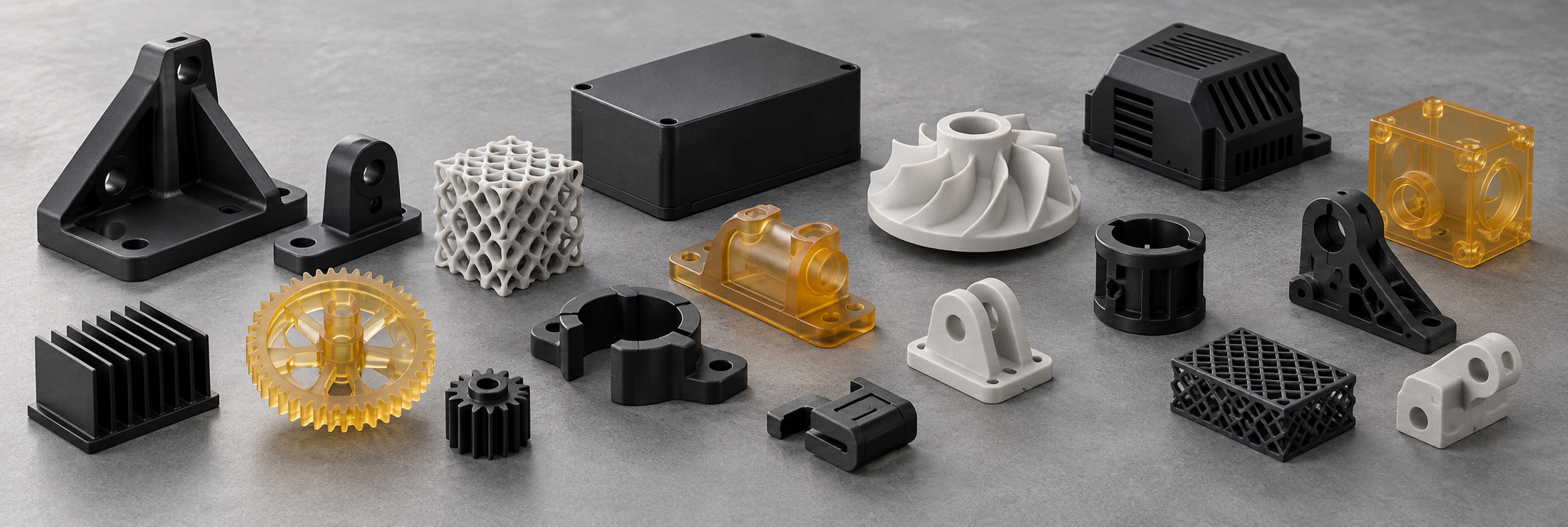
Prepare, modify & compare materials
Polymer compounding & extrusion
Blend formulations and produce experimental material using small-scale compounding or extrusion to connect processing choices with measured properties.
Prepare, modify & compare materials
Injection molding & hot pressing
Prepare molded or pressed specimens for controlled comparisons of formulation, processing, and mechanical performance.
Prepare, modify & compare materials
Resin & filament 3D printing
Produce exploratory prototypes, sample holders, and test fixtures using resin or filament printing to support iterative development.
Prepare, modify & compare materials
Thermal treatment & controlled atmospheres
Use furnace, induction, or controlled-atmosphere processing to investigate how thermal history changes material behavior.
Prepare, modify & compare materials
UV crosslinking
Explore UV-driven crosslinking conditions and evaluate their effects on network formation and subsequent material properties.
Prepare, modify & compare materials
Mixing, blending & reaction processing
Prepare experimental formulations and investigate processing variables using mixing and suitable laboratory reaction systems.
Prepare, modify & compare materials
Sectioning, grinding & polishing
Prepare representative surfaces and cross-sections for microscopy or mechanical evaluation while accounting for preparation artifacts.
Prepare, modify & compare materials
Cryomilling & sputter coating
Prepare challenging specimens through low-temperature size reduction or conductive coating for appropriate downstream analysis.
Prepare, modify & compare materials
Drying, evaporation & centrifugation
Condition, concentrate, or separate samples using suitable drying, evaporation, freeze-drying, or centrifugation approaches.
09
Degradation, release & development studies
Performance over time
+
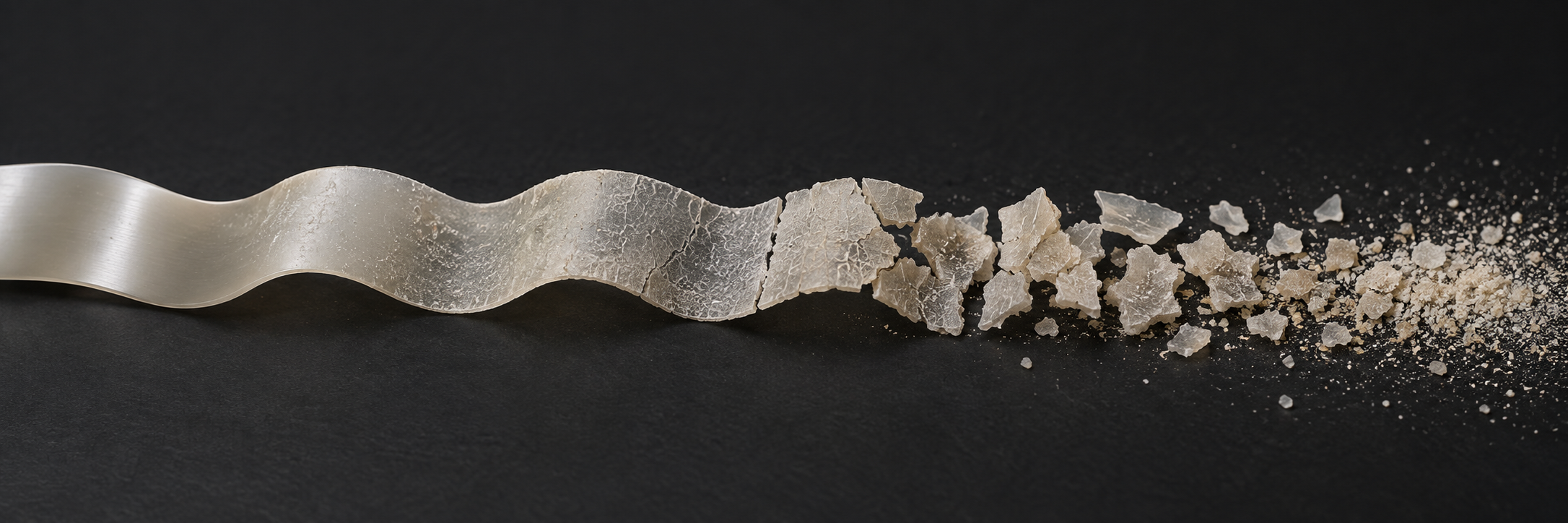
Behavior over time
Degradation studies
Track changes over time under defined exposure conditions. Combine mass loss, molecular-weight analysis, microscopy, and mechanical testing as appropriate to understand degradation pathways and retention of function. Use the results to tune material lifetime and compare formulations.
Behavior over time
Drug-release kinetics
Measure release profiles over time using analytical methods suited to the compound and formulation. Characterize burst release, release rate, and cumulative release, then relate those outcomes to composition, morphology, crystallinity, and processing.
Behavior over time
Custom performance & stability studies
Build a study around the behavior your product needs to deliver. Combine time-course measurements, formulation comparisons, and processing experiments to investigate performance changes and establish useful process–structure–function relationships.
Study design, sample suitability, and method availability are confirmed during scoping. Images illustrate laboratory work and materials; they do not depict our facilities or specific instruments.
PROCESS → STRUCTURE → FUNCTION
Understand the relationship.
Tune the outcome.
A test result tells you what happened. A process–structure–function relationship helps explain why—and what to change next. We design studies that connect processing conditions to material structure and functional behavior, building an experimental basis for high-fidelity tuning and performance prediction.
Control the inputs.
Compare formulation, thermal history, drawing, curing, and other processing variables to identify the factors that shape your material.
Measure what changes.
Resolve changes in crystallinity, molecular alignment, morphology, and composition using complementary characterization methods.
Predict what matters.
Relate structural changes to strength, flow, degradation, and release behavior. Test those relationships against new samples to assess predictive accuracy and guide the next iteration.
BUILT AROUND YOUR DEVELOPMENT WORK
For the next iteration.
And the team behind it.
Develop with evidence.
Compare candidate materials, troubleshoot unexpected behavior, and understand how processing changes performance. Focus your study on the decision in front of you.
- Medical product & biomaterial development
- Polymer, coating & formulation screening
- Degradation studies & drug-release kinetics
- Failure investigation & prototype comparison
Extend your capabilities.
Bring in complementary analytical methods or additional capacity for overflow projects. Coordinate the scope, sample handling, and reporting around your client’s needs.
- Specialized capability subcontracting
- Overflow testing support
- Scientific interpretation for complex samples
MORE THAN A MEASUREMENT
Science with a
product perspective.
Matthew Flamini, PhD
President & Founder
Biomedical Engineering · Materials Characterization
Matthew’s work connects polymer processing, material structure, and product performance. His research spans nanofibers, thermal treatments, mechanical properties, and controlled drug release, complemented by medical device development and analytical method development.
He brings experience with mechanical testing, thermal analysis, spectroscopy, and microscopy to help turn a product question into a focused experimental plan. Modulus Analytical combines his scientific guidance with additional technical expertise matched to the study.
LET’S START WITH YOUR QUESTION
What would you like
your material to do better?
Tell us about your material, the challenge, and the decision you need to make. We’ll discuss an appropriate scope for your development stage.
Discuss your project ↗


